
A BetterWho White Paper | 2026
Beyond the Type
An Evidence-Based Review of Personality and Behavioral Assessments in Hiring
Staffing and recruiting is one of the few industries that still treats personality instruments as settled science. The field that actually studies personality does not share that confidence. This paper closes that gap on purpose, by applying one published, checkable evidence standard evenly to every system it reviews.

AuthorMatthew Tringali, CEO & Co-Founder, BetterWho
TL;DR
Eleven findings. What the evidence actually shows.
01Personality and behavioral assessments are not equally scientific.
Some clear an independent, peer-reviewed bar. Most do not. The difference is measurable, not a matter of opinion.
02Only two systems in this review have independently replicated evidence linking scores to job performance: the Big Five and Hogan Assessments.
03DISC, MBTI, and the Enneagram have all been independently tested, and the results are unfavorable.
For Culture Index and Kolbe, no independent test of any kind was identified as of this review (August 2026). Neither position supports using any of them as an automatic disqualifying gate.
04The Predictive Index sits in between.
It has a real internal validation program. But almost all of it is vendor-conducted, not independently replicated.
05The Barnum effect explains why weakly validated instruments still feel uncannily accurate.
It was first shown in 1949 and replicated on a room of HR managers in 1958. This paper lets you experience it directly.
06Feeling “seen” by an instrument is not evidence the instrument measured you specifically.
Illusory correlation, groupthink, survivorship bias, and cognitive dissonance all predict that same reaction, regardless of accuracy.
07Even a fixed, stable “type” may be the wrong model of personality.
Decades of research point to behavior that is probabilistic and situation-dependent, not one label that travels unchanged into every room.
08The real risk is automation, not the tool itself.
A weakly validated instrument used as an automatic cutoff is far riskier than the same instrument used as one input a person reviews alongside other evidence.
09Personality testing falls squarely under U.S. EEOC selection-procedure law.
Without documented criterion-validity evidence, an employer faces substantial difficulty mounting the job-relatedness defense the law requires if adverse impact is alleged.
10Validity in one language and culture does not automatically transfer to another.
For a globally sourced candidate pool, an English-language instrument can end up testing English fluency instead of personality.
11Even the least controversial use case, team communication, does not clear a basic cost-benefit test.
The conversation these instruments prompt genuinely helps teams. The typology adds no benefit beyond that conversation, and adds a risk documented in the general research on labeling and expectancy effects: a label can become a fixed trait or a self-fulfilling expectation. When a free alternative gets the same benefit without that risk, this paper concludes the instrument is the worse choice, not just an unproven one.
From the Paper

Research Basis
- Peer-reviewed psychometric and industrial-organizational psychology literature (see References)
- Forer (1949) and Stagner (1958) Barnum-effect studies
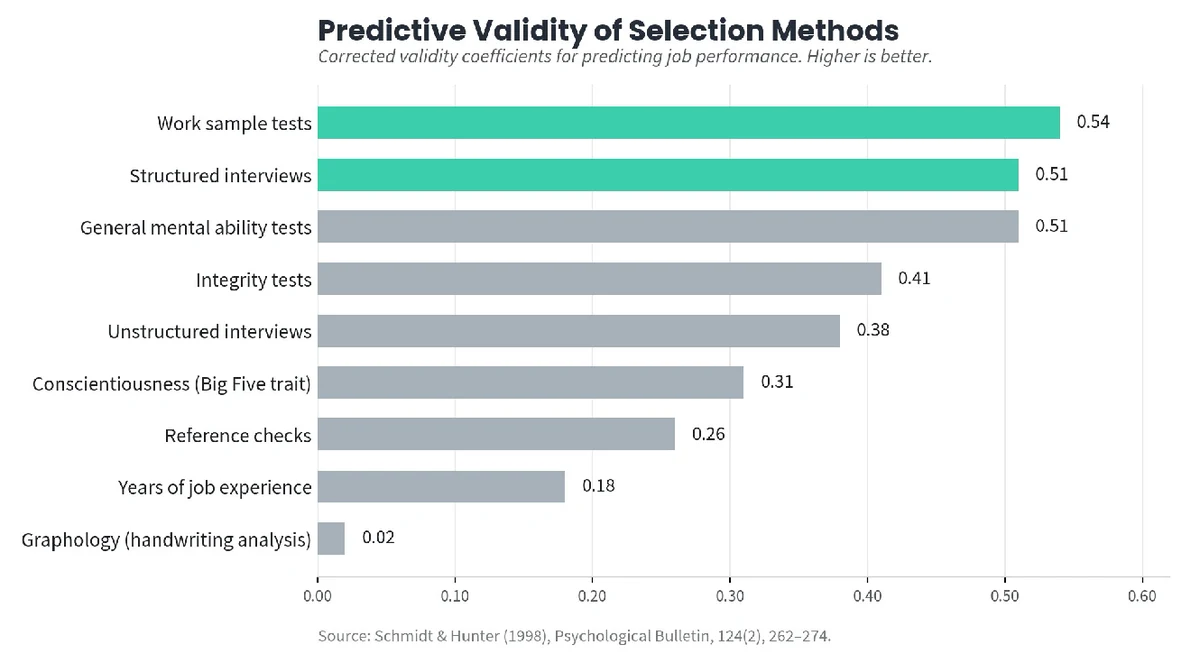
- Barrick & Mount (1991); Hogan & Holland (2003); Schmidt & Hunter (1998) meta-analyses
- Martinussen, Richardsen & Vårum (2003), Scandinavian Journal of Psychology
- U.S. EEOC Uniform Guidelines on Employee Selection Procedures (1978) and federal case law
- Cross-cultural measurement-invariance research (Van de Vijver & Tanzer; Ellis, 1989)
Author
Matthew TringaliCEO & Co-Founder, BetterWho
Hiring for a Remote Seat?
RTM Direct leads the search and screens candidates for remote roles, while you interview the people we recommend and make the hiring decision.