
A BetterWho White Paper | 2026
The Bonus Trap
Why Pay-for-Performance Fails Small Property Management Companies, and What Builds a Self-Managing Team Instead
A bonus does not create a self-managing employee. It creates a spreadsheet-managed employee. Self-management is built from direction, structure, feedback, and coaching, and this paper documents the evidence and the architecture.

AuthorMatthew Tringali, CEO & Co-Founder, BetterWho
TL;DR
Ten findings. Readable in five minutes.
01Everyone wants a self-managing team. A bonus plan is the one input that cannot produce it.
In the research, self-management is autonomous motivation; contingent pay produces controlled motivation, people regulated by the formula instead of by internalized standards.
02The evidence is a gradient, not a verdict.
Incentives reliably buy quantity of simple, countable, individually controllable output (r = 0.34) and have no reliable effect on quality. Those conditions describe windshield installation. They do not describe property management.
03Your comp structure is a filter before it is a motivator.
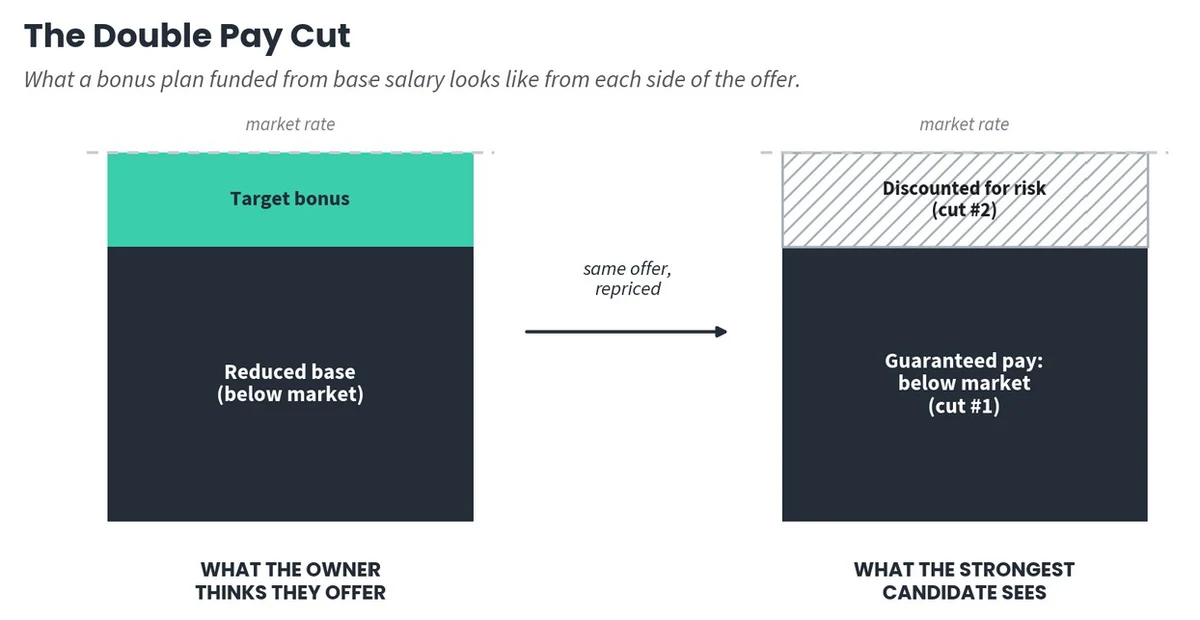
In a randomized experiment, higher guaranteed wages attracted applicants with higher IQ, better personality profiles, and higher acceptance rates. Risk-averse candidates, disproportionately women, sort away from variable pay. Cutting base to fund bonuses is a double pay cut, and your best candidates reprice it or walk.
04Pay-for-performance is a big-company tool.
Its incidence rises with firm size because it solves a monitoring problem a 10-person office does not have, and it requires statistically stable metrics a small portfolio cannot produce. Founder-run firms score worst on incentive design in the World Management Survey.
05A monthly bonus is salary.
Under the FLSA, nondiscretionary bonuses must be included in the regular rate of pay for overtime (reaffirmed in DOL Opinion Letter FLSA2026-2, January 2026). Excluding them is one of the most common wage violations. If your hourly staff earn monthly bonuses, check your overtime math this week.
06The expected bonus is a pit of vipers.
Once counted on, receiving it produces nothing and missing it functions as a pay cut. Falling behind a bonus reference point reduced satisfaction and subsequent performance in field data, and missing a contingent reward drops self-efficacy and performance with it. A monthly plan runs that lottery twelve times a year.
07Pricing a core duty converts it into a purchasable option.
In a field experiment, paying a cash bonus for attendance made workers show up less. The bonus signaled the obligation was optional. The research points one direction: a duty the job requires is the last thing to put a price on.
08Bonusing KPIs is lazy management.
Specific difficult goals plus feedback drive performance without contingent cash, at effect sizes comparable to financial incentives, for free. In a head-to-head field experiment, management meetings alone raised profit; adding a cash bonus wiped out the benefit of the meetings.
09Self-management is a built environment.
The documented ingredients are a compelling direction, enabling structure, competence feedback, coaching, and belonging: core values, mission and vision, KPIs, one-on-ones, feedback loops, and meeting rhythms. Compensation appears in the team-effectiveness research only as hygiene, and an annual profit share is a values decision, not a performance lever: it will not change behavior, and the evidence gives most owners little reason to adopt one.
10These mechanisms are human, not contractual.
Reference points were first documented in independent contractors. Motivation needs replicate across cultures. The findings govern employees, freelancers, and global remote team members alike; only the legal treatment differs, and this paper scopes its legal sidebars accordingly. One global specific: the thirteenth month is a near-universal expectation for Philippine and Latin American team members. Address it in the offer, either baked into a market-rate salary or paid at year end, never by silence.
From the Paper
Research Basis
- Jenkins, Mitra, Gupta & Shaw meta-analysis, Journal of Applied Psychology (39 studies)
- Deci, Koestner & Ryan meta-analysis, Psychological Bulletin (128 experiments)
- Condly, Clark & Stolovitch meta-analysis, Performance Improvement Quarterly (45 studies)
- Cerasoli, Nicklin & Ford 40-year meta-analysis, Psychological Bulletin (k=183, N=212,468)
- Cala, Havranek, Irsova, Matousek & Novak meta-analysis of economics evidence, CEPR DP 17680
- Weibel, Rost & Osterloh meta-analysis, Journal of Public Administration Research and Theory
- Lazear, Performance Pay and Productivity, American Economic Review (Safelite, ~3,000 workers)
- Dal Bo, Finan & Rossi randomized wage experiment, Quarterly Journal of Economics
- Dohmen & Falk sorting experiments, American Economic Review
- Lemieux, MacLeod & Parent, Performance Pay and Wage Inequality, QJE
- Locke & Latham goal-setting research program (1,000+ studies)
- Gagne & Deci, Self-Determination Theory and Work Motivation, JOB
- Hackman, Leading Teams, Harvard Business School Press
- Bloom & Van Reenen, World Management Survey
- Sliwka et al. field experiments on bonuses (Management Science; German retail)
- U.S. DOL Fact Sheet #56C; DOL Opinion Letter FLSA2026-2; 29 U.S.C. 207(e), 213(f)
- BetterWho 2026 State of Remote Property Management Hiring (57 PM companies, 90+ RTMs)
- BetterWho RTM placement data, ~3,500 applicants/month
Author
Matthew TringaliCEO & Co-Founder, BetterWho
How Do You Pay Your Team Today?
BetterTeam Consulting helps you give every role a clear owner, clear decisions and a clear way to measure the work, so everyone knows what is theirs.